

Rome has always been the centre of Christianity, a destination for pilgrims from all around the world. Here history and faith are intertwined. Few know that Rome has always been the centre of artistic freedom, crossing every border and every religion. Artists and free spirits with political or religious constraints travelled to the “cradle of the popes” to paradoxically find the freedom not granted in their native lands.
We are, therefore, ready for a hypothetical journey into the still-present past, in search of the milestones of non-Catholic art.
People who dare to protest and make change and history are the eclectic personalities who have come to Rome and left their mark. They have told their own story, described their own century, the Eternal City, or the whole Italy in detail. They actually made a difference. And it is to discover the daring artists who subverted the rules, that we are visiting the Non-Catholic Cemetery, to wander through the “crosses” in search of delightful stories.
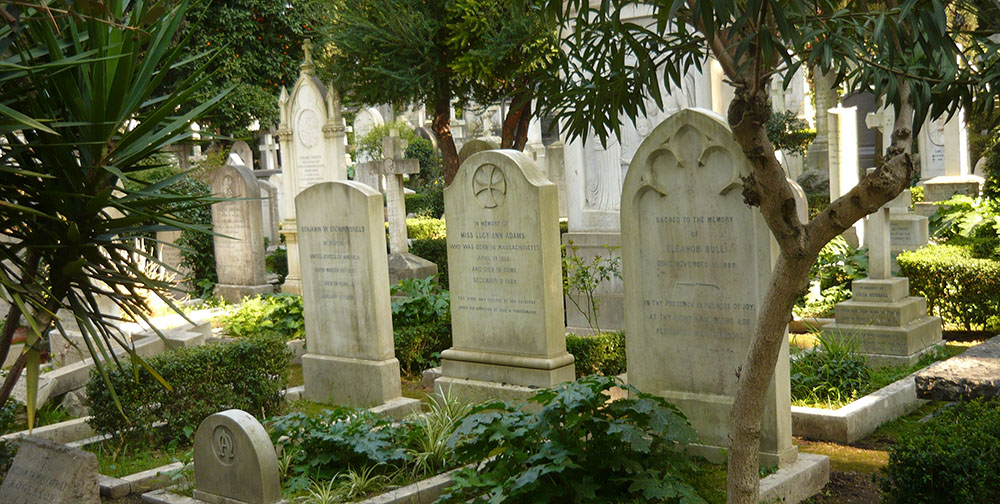
Non-Catholic Cemetery in Rome
It is located between the districts of Testaccio and Ostiense, in the neighbourhoods where the “Romanità” and the protest are pursued with the angry force of street art, where the sacred Basilica of St. Paul Outside the Walls meets the profane nightlife, in the shadow of the industrial architecture of the Centrale Montemartini. Next to the Pyramid of Cestius, the enormous, monumental tomb of Caius Cestius, erected in honour of the plebeian tribune over 2000 years ago, the Non-Catholic Cemetery hosts the mortal remains of those who, not being Catholics, could not be buried in the city. In the coolness of the old cypresses, protestants, jews, orthodox Christians, suicides and actors, mostly foreigners, are buried here with tombstones in every language, so the place has rightly deserved the title of “cemetery of artists and poets.”
Among the illustrious “unconventional” Italians we find Carlo Emilio Gadda, a writer who lived between the late nineteenth century and the 1970s and changed the rules of the traditional structure of the novel, masterfully mixing dialects and neologisms, narrating in a critical and lucid style the reality of his time. Often censored, he was a true innovator in the field of literature.
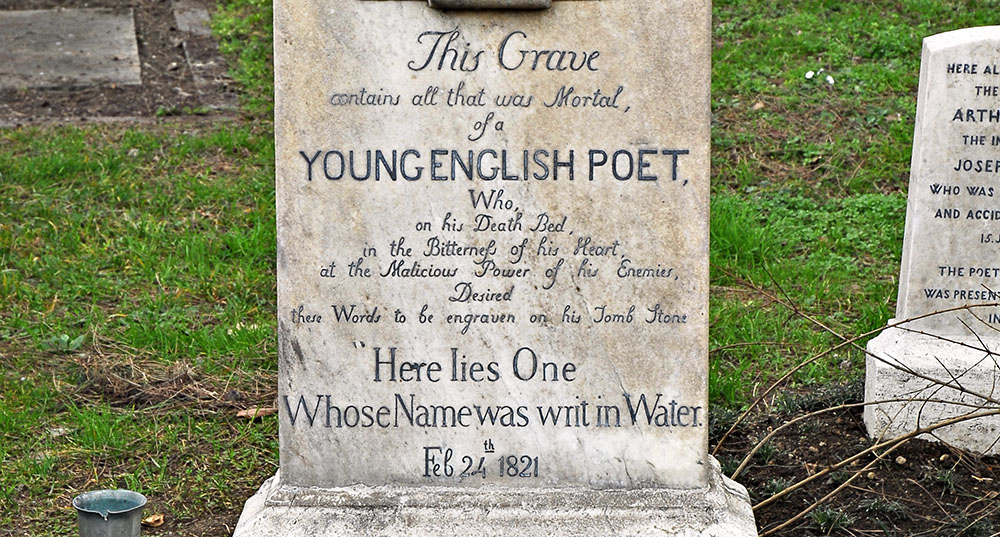
Non-Catholic, English, Protestant cemetery, John Keats
The site is better known as “the Englishmen cemetery”. Walking through its lush greenery we find the tomb of John Keats, who died from tuberculosis at the age of 25, in 1821. We can read on his tombstone: “Here lies one, whose name was writ in water”. The English poet chose these words to define himself and his work: floating and elusive.
We feel the same sensation in his house in Piazza di Spagna. Open to the public since 1909, the Keats-Shelley House is home to letters, manuscripts, portraits and relics of Romantics and followers of Keats, such as Oscar Wilde and Walt Whitman.
“The fountains are enough to justify a trip to Rome!”, wrote the great English poet Percy Bysshe Shelley after his stays in Rome, referring to fountains like the Bernini’s Barcaccia at the foot of the Scalinata di Trinità dei Monti, where he lived. Anti-conformist and idealist, he was as much denigrated in life as loved by literary followers for centuries to come.
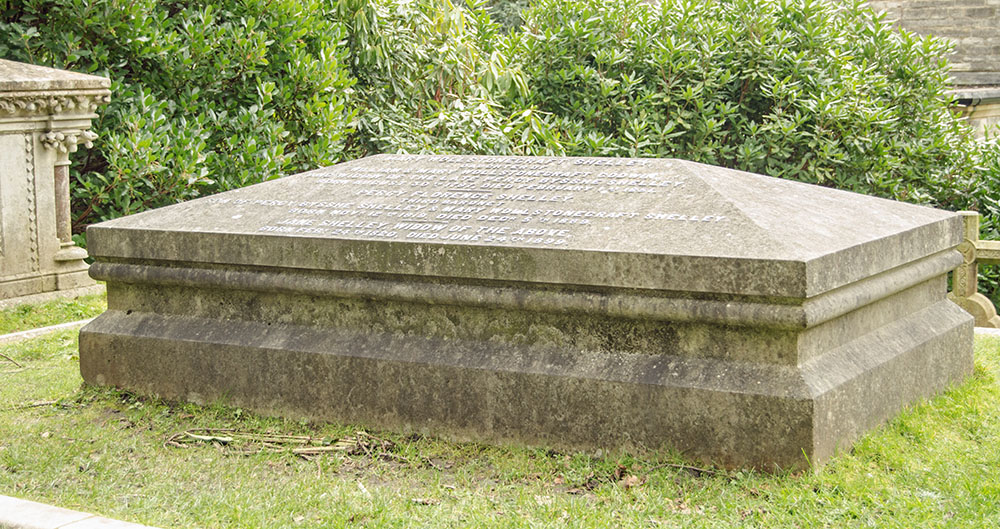
The remains of this Romantic poet are also preserved in the Non-Catholic Cemetery of Rome, except for his heart, buried in Bournemouth next to his widow, Mary Shelley, who imagined a Gothic creature, who became the symbol of love and fear for all eternity with the name of Frankenstein.
Shelley funerary epigraph recalls his terrible death in the waters of the Tyrrhenian Sea with verses from the “Tempest” of Shakespeare: “Nothing of him that doth fade, but doth suffer a sea change, into something rich and strange”.
Close to these illustrious English poets, Lord George Byron only lived 22 days between Via Condotti and Via Borgognona. No plaque at No.66 of Piazza di Spagna reminds us of this other innovator of literature, whose brief exile coincided with Shelley’s visit to the Roman residence of Keats. They were ready to fill their works with the most romantic emotions, inspired by the ruins of the Eternal City. It was the year 1817 and, at the end of the Grand Tour, Lord Byron plunged into the Roman atmosphere, the aristocratic theatres, the cultural salons and went on bizarre rides on horseback in the moonlight.
Eccentric and melancholic, the ancient past emerges, vivid and powerful, from his nostalgic writings on lost classicism, inspired by his nocturnal walks inspired. With the contrast between the magnificent, sumptuous palaces and the small plebeian squares, Rome was the perfect place for the inspiration to write about his Romantic Heroes, fearless adventurers, perpetually balancing between good and evil.
in order to admire the Roman panorama and write poetry, he went as far as the hills of the Castelli Romani, where he wrote “Lo, Nemi! navell’d in the woody hills.”
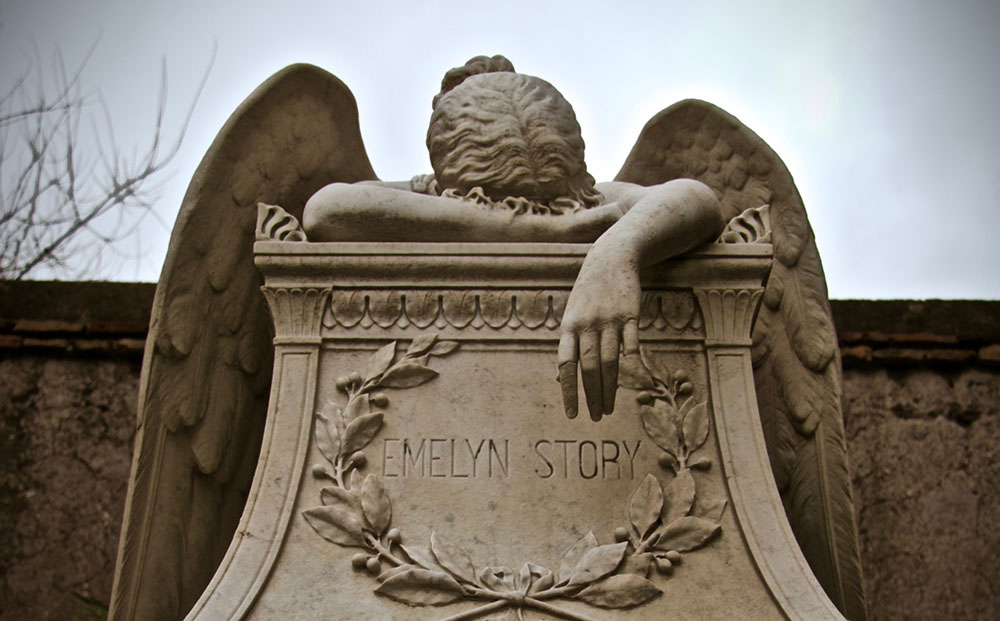
Angel of Grief
In the Non-Catholic Cemetery we stop in front of its most famous emblem, the Angel of Grief. It is a marble sculpture by William Wetmore Story, the 19th-century American sculptor buried here with one of his sons and his wife, to whom he dedicated the weeping angel lying across the tomb.
In the mid-1800s, William Wetmore Story moved to Rome, and his apartment in Palazzo Barberini became a salon of cultural exchange for Italian and foreign writers, musicians, and artists. The works and the very burial site of an American artist in the English Cemetery symbolized the entrance of the New World culture into the Old World.
Last but not least, we can mention the tomb of Romeo. Nothing to do with the romantic story of Romeo and Juliet… Romeo is a cat! Emblem of the characteristic communities of cats, seen almost everywhere in the capital, Romeo’s small grave lies next to the one of Antonio Gramsci. The friendly cat was loved by visitors, who gave him a typical roman name and the tombstone has a plaque with his lovely silhouette.
These artists, each in their own way, had the courage to effectively change history, they narrated of a different world, they have moved generations of writers and readers. Now it’s our turn!
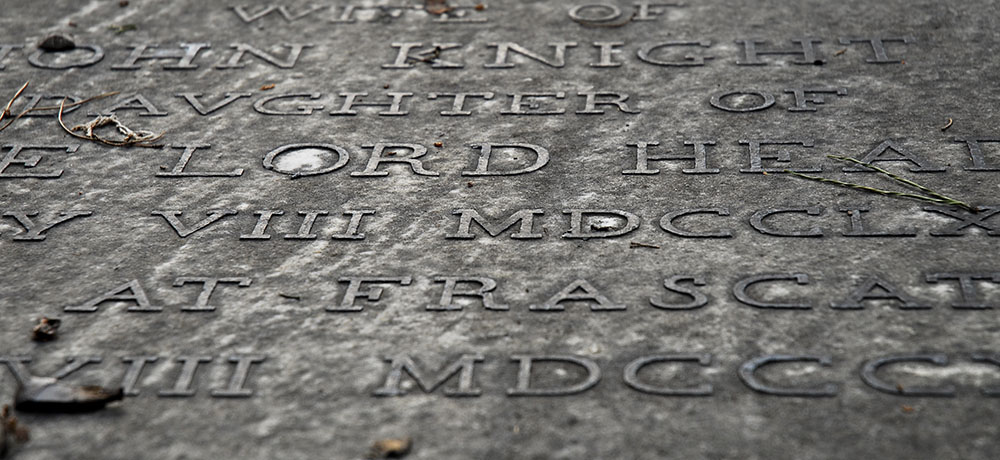
Non-Catholic, English and Protestant cemetery