

The Gran Sasso e Monti della Laga National Park spans the Abruzzo, Lazio, and Marche regions, crossing forty-four municipalities within the provinces of L’Aquila, Teramo, Pescara, Rieti, and Ascoli Piceno.
The park boasts a wide variety of landscapes: from the lunar scenery of the high peaks to the vast beech, oak, and chestnut forests, where the roar of deer echoes in the autumn air.
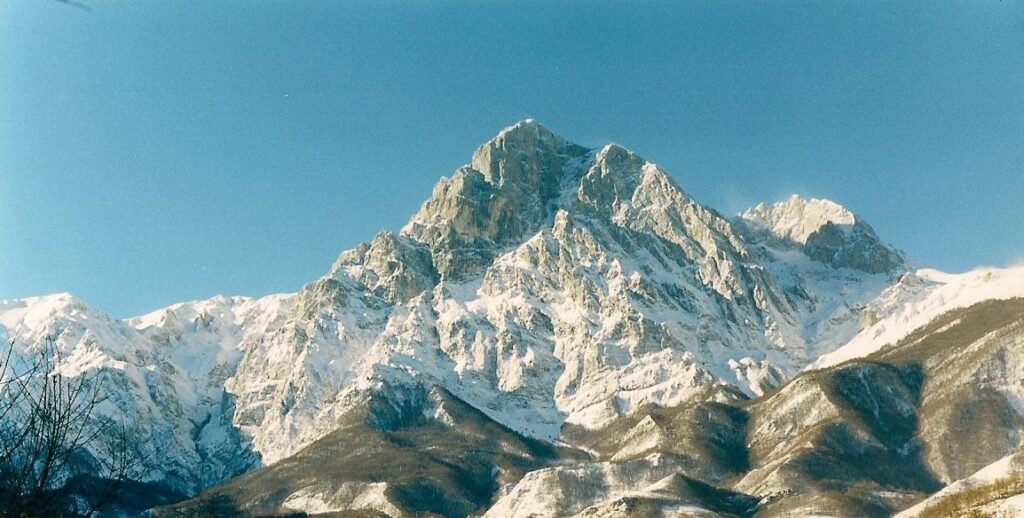
A View of Corno Grande and Corno Piccolo
Among the numerous mountains present in the park, the Gran Sasso, the highest massif in the Apennines, undoubtedly stands out. From the Campo Imperatore Plateau, nicknamed Little Tibet, it is possible to climb up to Corno Piccolo and Corno Grande, the latter being the highest peak, at 2,912 metres above sea level.
The hiking route that leads to the summit of Corno Grande is rather hard, but the mountain complex also offers easier trails providing equally breathtaking views.
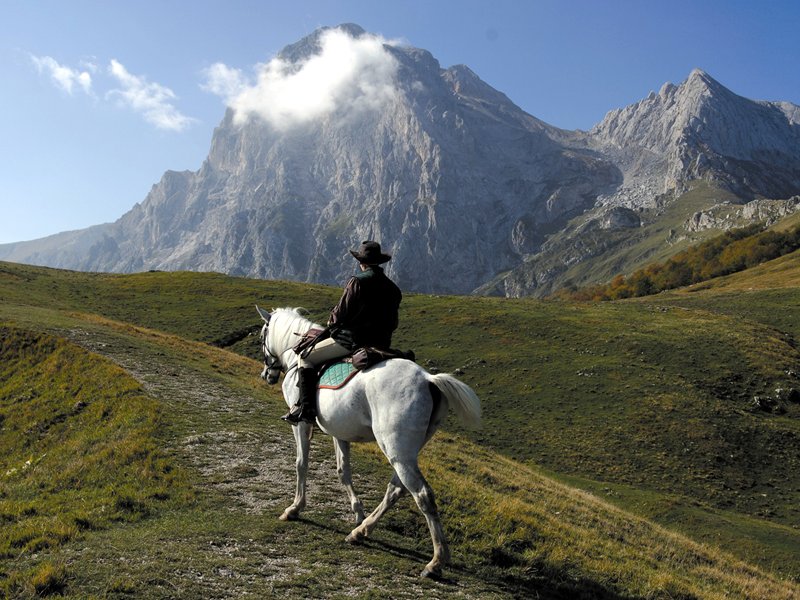
Gran Sasso Horse Trail, photo from gransassolagapark.it
At the foot of Gran Sasso, amidst picturesque agricultural landscapes and open fields, stand several fortified villages and castles.
The part of the park which includes Lazio hosts sandstone farmhouses, chapels, and votive shrines, as well as the noteworthy Lago Negro Wetlands. Accumoli and Amatrice, in the province of Rieti, are the starting points of the hiking trails leading to the Laga Mountains. Here, the territory is gentler than the one on the Abruzzo side, with beech and fir forests dominating the territory up to an altitude of 1,800 metres, where delicious blueberries grow. In addition, the numerous streams, watercourses, and waterfalls present along the way will make our walk even more enchanting.
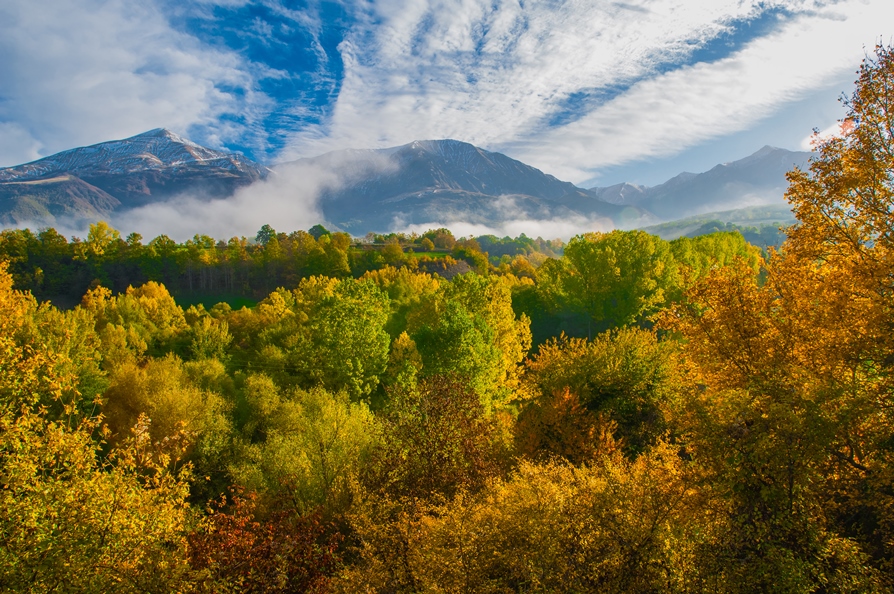
The Amatrice basin with the Laga Mountains in the background
Despite its almost total destruction in the earthquake of August 24, 2016, Amatrice remains listed among the “Most Beautiful Villages in Italy”, thanks to its extraordinary natural scenery. The village lies within a basin characterized by woodlands, pastures, orchards, and open countryside, and crossed by waterfalls and streams. A dense network of trails runs through this area, like a stretch of the “Sentiero Italia”, which covers the entire backbone of our peninsula, offering hiking opportunities in the lush surrounding nature.
Numerous streams flow down from the nearby Laga Mountains, a territory dotted with small rural churches, some of them hosting valuable works of art.
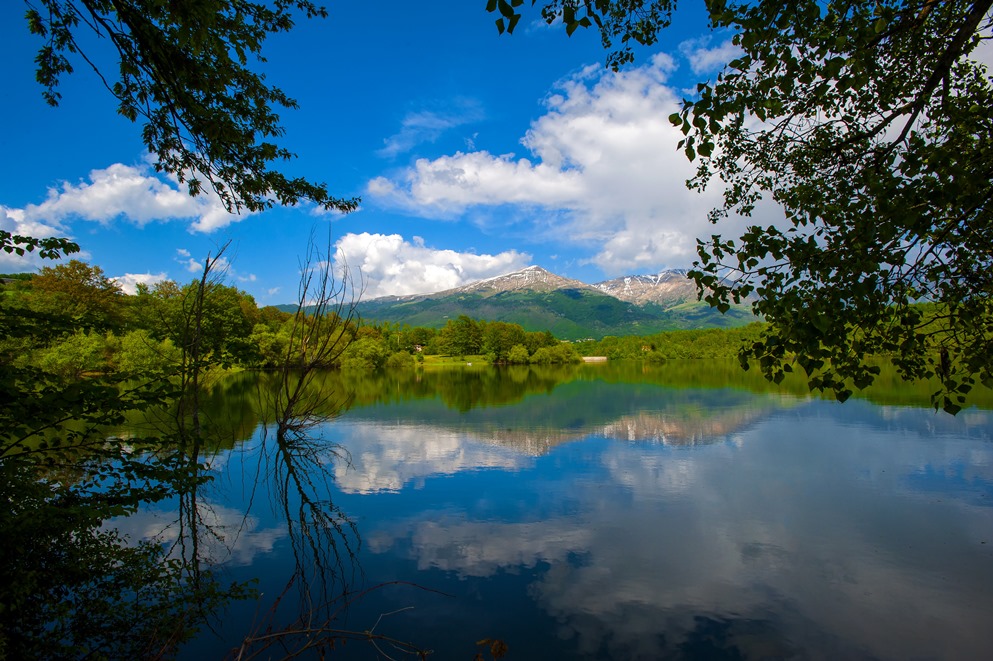
Lake Scandarello
An easy trail leads to the Lago Scandarello, an artificial fishing lake, immersed in an enchanting atmosphere due to its surrounding vegetation.
Several other tracks to be followed on foot, on horseback, or by mountain bike, reach the many nearby hamlets, while most challenging routes climb up to the highest peaks of the Laga Mountains.
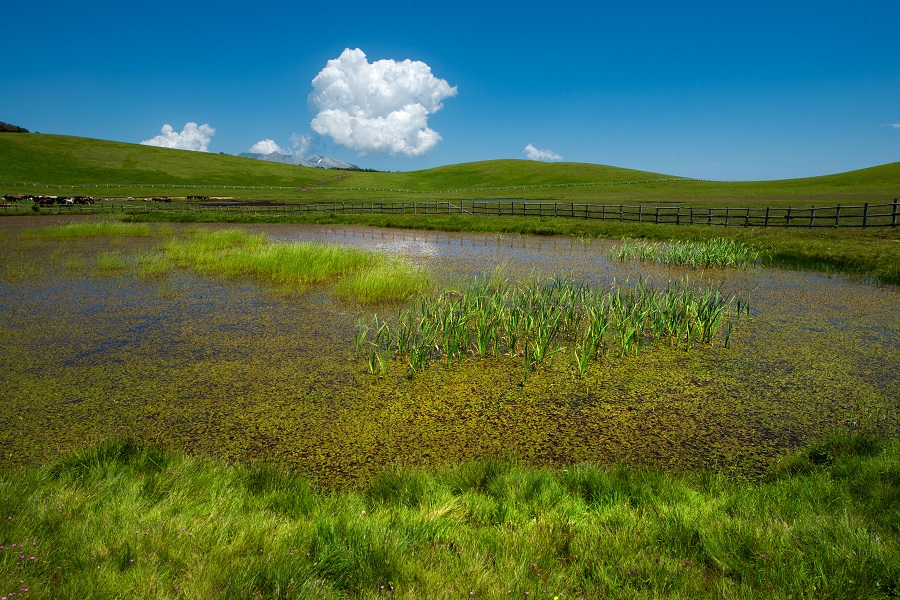
The Lago Secco WWF Oasis
The Laga Mountains can also be reached via a network of routes starting from Accumoli, an area rich in springs, streams, peat bogs, and glacial lakes, such as Lago Secco, located within the WWF Oasis of the same name. The evocative trail leading to the lake, of great natural interest, starts from the hamlets of Illica and Poggio d’Api, and, after crossing Lake Selva, arrives at Lago Secco in a couple of hours. Here lays a wetland environment characterized by a rich network of streams and springs. This enchanting lake at the foot of the Pannicaro Woods is unique in the Central Apennines, and, despite its name, it is permanent and home to a thriving colony of amphibians. This marshy land preserves traces of several past geological eras and hosts various specimens of flora and fauna, such as the common frog and the alpine salamander, considered rare living fossils from the glacial era. While ascending the path towards Lago Secco, among wild roses and brooms, and then through a forest and several clearings, we come across the beautiful springs of Agro Nero. Its small peat bogs provide the ideal habitat for extremely rare species of flora, like the willow Salix Pentandra and the wild aquatic Vallisneria Spiralis, with its distinctive ribbon-like leaves, a shelter to aquatic wildlife.
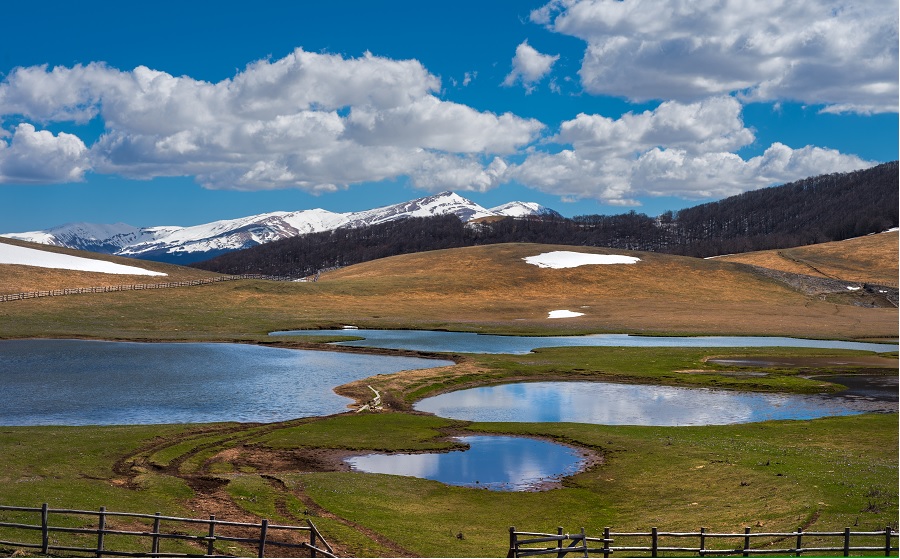
The Laghetti dei Pantani
Not to be missed are also the Laghetti dei Pantani, small glacial lakes located on a plateau at an altitude of approximately 1,580 metres, between the Monti Sibillini National Park and the Gran Sasso e Monti della Laga National Park. Due to the variety and rarity of its flora and fauna, the site has been designated a Site of Community Importance. Here, in summer, it is possible to enjoy the lush nature and spot horses, cows, and bulls grazing freely, while, in winter, long snowshoeing excursions can be practiced.
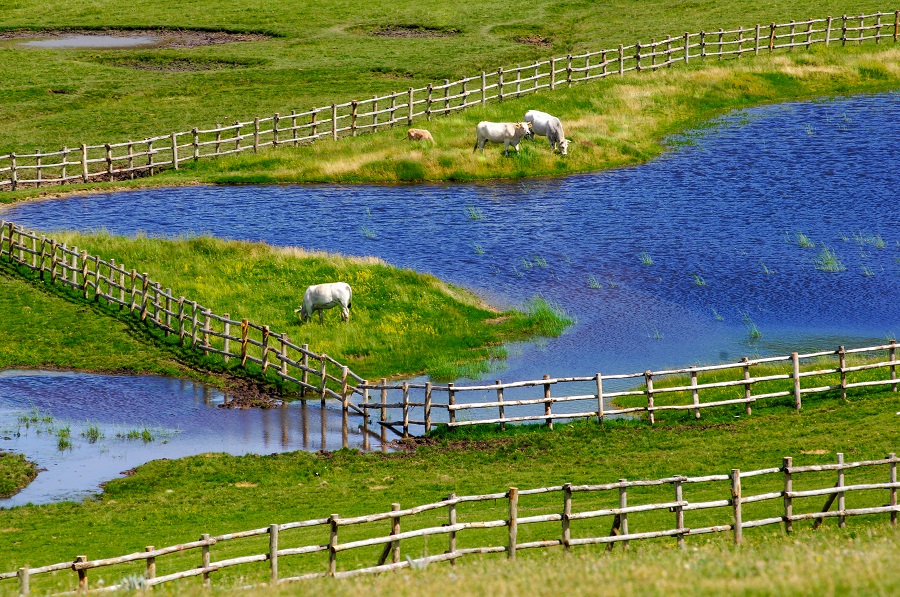
A Pasture on the Laghetti dei Pantani area
Between Accumoli and the lakes, lies a picnic area called “Le Coste”. Nearby, stands a farm where children can interact with animals and the Church of Madonna delle Coste, an old pilgrimage destination, likely a former hermitage, dating back to the 12th or 13th century. In July and August, a rare phenomenon that only occurs in another Italian lake, the Lago Tovel in Trentino, takes place. The waters of the small lakes turn red due to the presence of the Alga Euglena Sanguinea in combination with the high temperatures, a truly amazing sight.