

Water has made a major contribution to the magnificence of Rome, testified by its fountains, aqueducts, and hydraulic networks, indelible symbols of an ancient love story between the Eternal City and water. We begin by describing the Fontana del Facchino in via Lata and continue with the three fountains in Piazza Navona, passing by the Trevi Fountain, the Fontana delle Tartarughe and finally reach “er Fontanone”, discovering the history of these tributes to beauty.
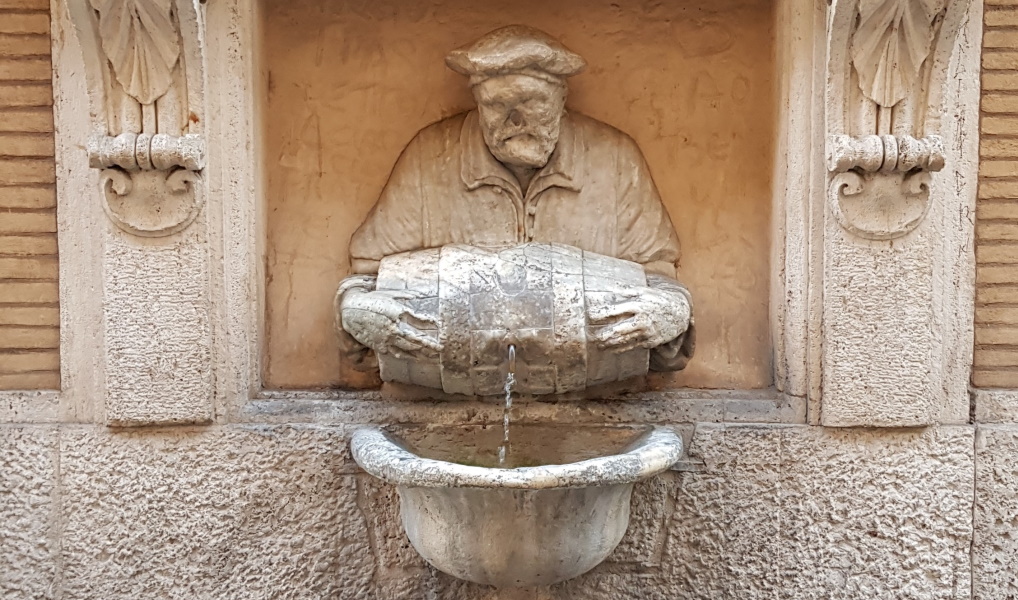
ROME Fontana del Facchino in via Lata – www.sovraintendenzaroma.it
Anonymous messages against the powerful were left by the Romans next to the “talking statues“. The Fontana del Facchino (Fountain of the Porter), the smallest one, positioned in via Lata, depicts a man carrying a barrel, the acquarolo or acquaricciaro, who sold the water from public fountains to the families. The statue portrays a man with a face disfigured by the stones thrown at him, being mocked and feared, due to his resemblance to Martin Luther in the clothing.
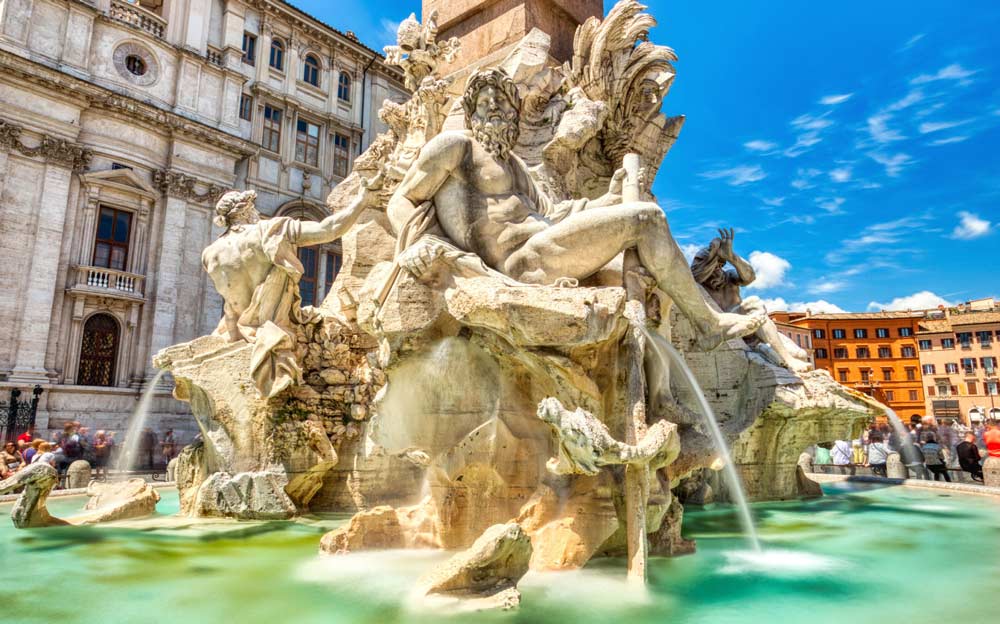
Fontana dei Quattro Fiumi – Piazza Navona
In Piazza Navona, you will marvel at the gorgeous Fontana dei Quattro Fiumi and the Moro and Nettuno Fountains. The square was, in the history of ancient Rome, the first masonry stadium, whose perimeter is still detectable today. Many wrongly believe that “Navona” refers to the water games held there in August in the Baroque period, or to the practice, in the nineteenth century, to fill the square with water, in order to give relief from the heat to the citizens. Actually, the name of the square comes from the Agone, the athletic games celebrated there by the Ancient Romans.
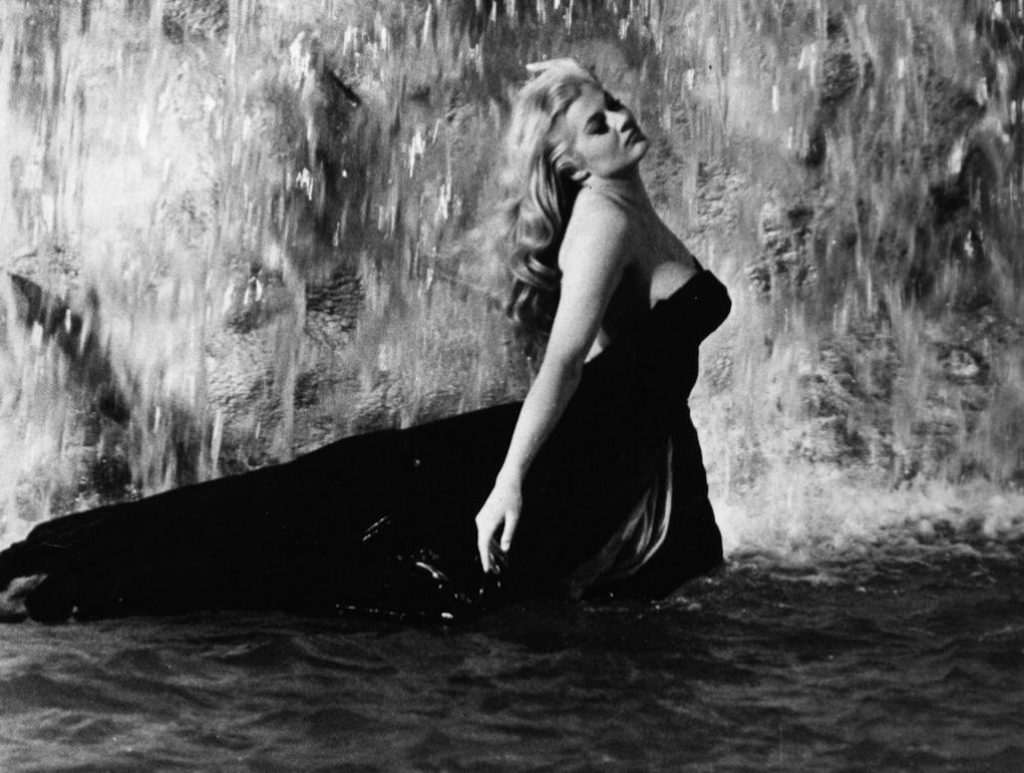
Fountains have been the settings of countless cult movies, such as “La dolce vita”, where Anita Ekberg bathed in the Trevi Fountain calling Marcello Mastroianni.
“Marcello come here”
The famous comedian Totò even tried to sell the Trevi Fountain to a gullible tourist in “Totòtruffa 62”. Fellini, Monicelli, Pasolini, Sorrentino and Woody Allen are among the many directors who chose the fountains of Rome as a film set.
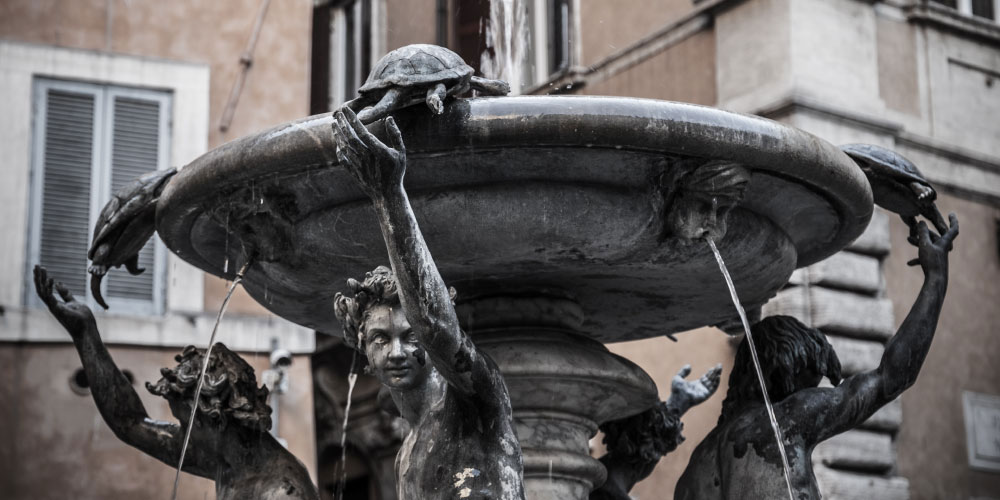
Fontana delle Tartarughe
The Fontana delle Tartarughe, in fine African marble, was designed by Giacomo della Porta. The four turtles are copies of the bronze originals, preserved in the Capitoline Museums. The Fountain stands in Piazza Mattei, in the heart of the Jewish Ghetto. It portrays four bronze ephebes in symmetrical poses, holding the tails of as many dolphins and resting their foot on the heads of the fish, from whose mouths the water flows into huge shells. The ephebes raise their free arm towards the edge of the upper basin, pushing the turtles into the water to make them drink. The cute animals were added to the Fountain by Gian Lorenzo Bernini in 1658, during a restoration commissioned by Pope Alessandro VII.
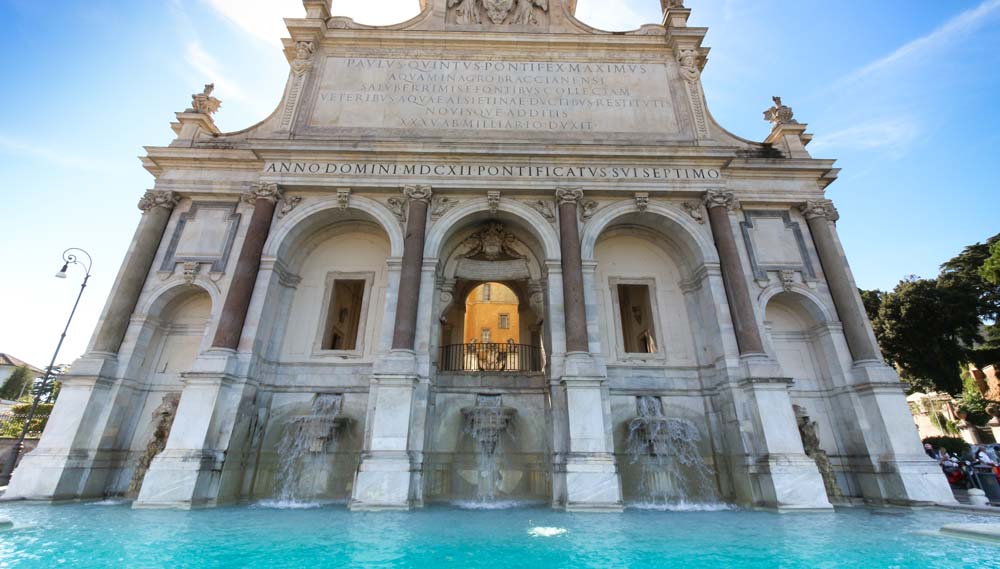
Fontana dell’Acqua Paola “Il Fontanone”
The Fontana dell’Acqua Paola was commissioned by Pope Paolo V at the beginning of 1600 to Giovanni Fontana. The “Fontanone” on the Gianicolo Hill, immortalized in the Oscar-winning film “La Grande Bellezza”, collects its water from the Lake of Bracciano.
“The fountains are enough to justify a trip to Rome”, ”
So said the English poet Percy Bysshe Shelley after discovering the magnificent monumental fountains during his Roman stays.