

Whether you are a tourist or a resident, you have certainly answered “of course!” Nevertheless, we are going to show you two less known attractions.
Probably everyone knows that Piazza di Spagna owes its name to the Spanish Embassy to the Holy See in Palazzo Monaldeschi, and its staircase with its 136 steps to Benedetto XIII, the Pope who asked, during the 1725 Jubilee, to connect the Spanish area with the church of the Santissima Trinità dei Monti, officiated and attended by the French.
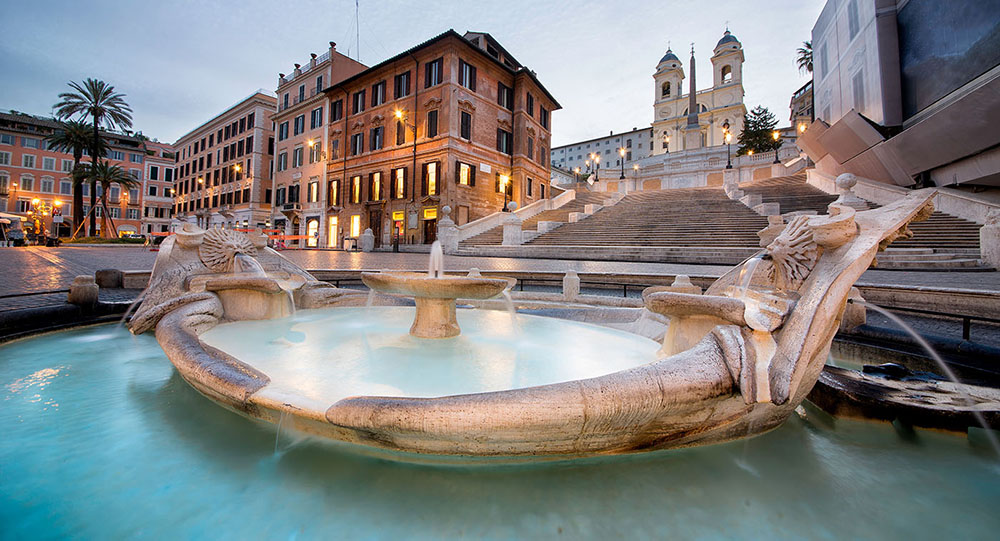
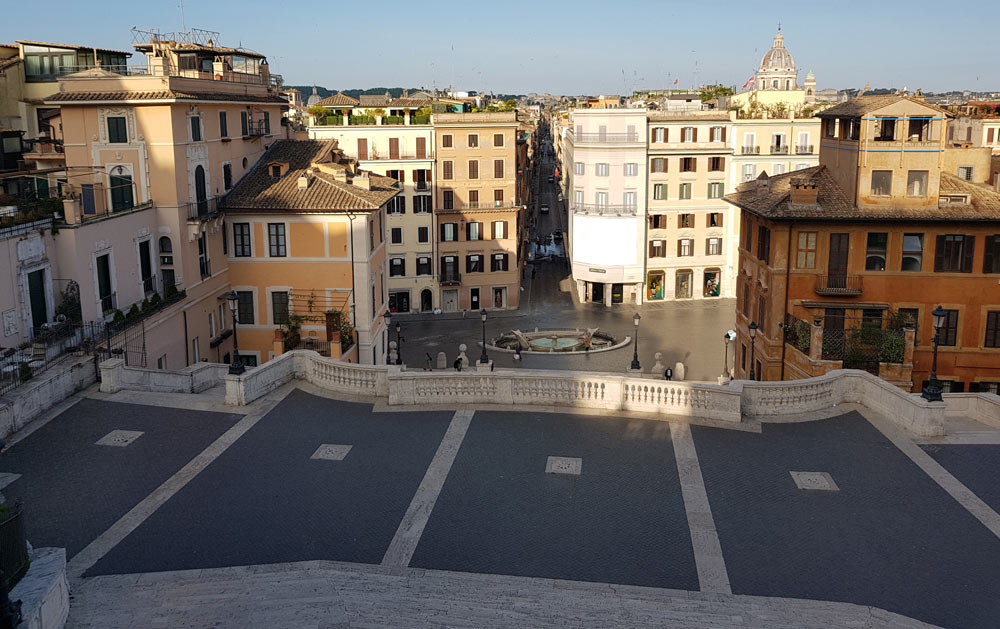
The view that can be enjoyed from the terrace of Trinità dei Monti is very impressive: from the Baroque fountain of the Barcaccia by Pietro and Gian Lorenzo Bernini, to via del Babuino, the street which, with via del Corso and via di Ripetta, connects Piazza del Popolo with the Rione Campo Marzio, forming the famous Tridente.
However, maybe not everybody knows that, near the church of Trinità dei Monti, the House of Monsters, inspired by the surreal Sacro Bosco di Bomarzo, can be visited. In the Palazzetto Zuccari, in via Gregoriana 30, you feel like being swallowed down in hell! You’ll see a Mannerist architecture, with doors and windows in the shape of huge jaws and wide-open eyes, a curved nose and a frown. The effect was very disturbing at that time and, 300 years later, even Gabriele D’Annunzio described it in the novel “Il Piacere “.
The Palazzetto was the residence of Federico Zuccari, the painter and art critic, who conceived it in 1592 after being fascinated by the Parco dei Mostri in Bomarzo. He wanted a whimsical residence where visitors, frightened at first, could be amazed by what they would discover inside, the enchanting garden, now disappeared, and the magnificent frescoes, works by Zuccari himself, such as “Hercules at the crossroads between vice and virtue “.
In this atmosphere of unique contrasts, Zuccari organized cultural gatherings about his life passion, the arts. In the three centuries that followed, the structure of the Palazzetto was modified. In the mid-1700s, it was transformed into an ecclesiastical school and in 1900, Henriette Hertz had a three-storey building, the Hertziana Library, built in the garden. Thanks to the books inherited from the German collector, the library is today still specialized in the history of art. It has therefore remained a site of art and culture, as Federico Zuccari wished, preserving the strong “shocking” effect, and hosting new modern spaces. The Palazzetto Zuccari can be visited free of charge by reservation only.
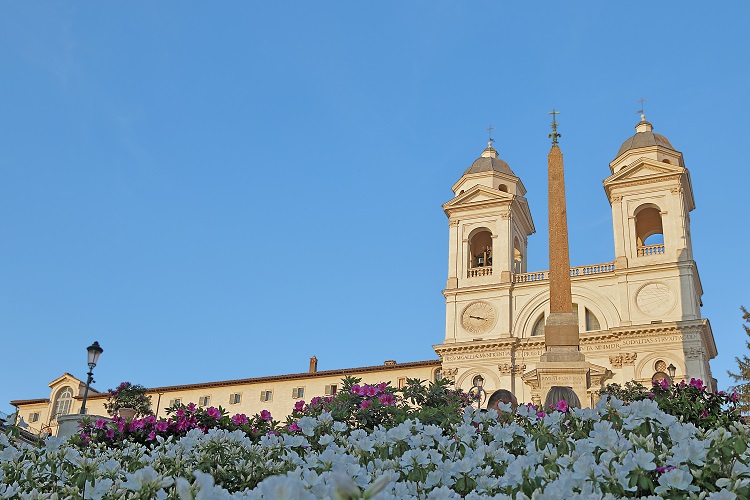
Santissima Trinità dei Monti
Perhaps everyone knows that the Santissima Trinità dei Monti is known as “the Roman church of the Kings of France”. It is, in fact, one of the five churches in Rome where French is spoken, together with San Luigi dei Francesi, San Nicola dei Lorenesi, Sant’Ivo dei Bretoni and Santi Claudio e Andrea dei Borgognoni. It was built in a Gothic style between 1502 and 1519 and later the single nave has been flanked by a building surmounted by two symmetrical bell towers designed by Giacomo della Porta and Carlo Maderno. The works continued throughout the 1500s and the church was consecrated in 1595.
However, maybe not everyone knows that, on top of the famous Spanish Steps, “magical” artistic treasures can be admired: the anamorphoses and the astrolabe. Next to the church of the Santissima Trinità dei Monti lies the Convento della Comunità del Sacro Cuore e della Fraternità Monastica di Gerusalemme, built between 1530 and 1570 by the King of France Charles VIII for the French religious Ordine dei Minimi. It was founded by Francesco da Paola, the saint who miraculously crossed the Strait of Messina on his cloak. The cloister is decorated with portraits of the saint and of the kings of France, while the refectory was painted by the Jesuit Andrea Pozzo in 1694. It is here that the curious paintings of the Padri Minimi Emmanuel Maignan and Jean François Nicéron are kept: the anamorphoses.
What is an anamorphosis? It is a painting in a technique conceived in the early Renaissance, peculiar for its perspective. An optical effect allows you to detect the subject of the work only from a certain point of observation. It is difficult to explain, but easier once you admire it.
Strolling through the corridors on the first floor you will discover the two anamorphoses. Admire the best-preserved paintings from the two angles, the one from 1642, which portrays San Francesco da Paola and the one with the saint praying under an olive tree.
Now, in front of you, a coastal landscape with a sailboat headed to a port. Here too you can see San Francesco da Paola but with one of his brothers, as they miraculously cross the Strait of Messina.
Between the two anamorphoses we find the catoptric astrolabe, a scientific marvel created around 1640, a sundial with a reflecting surface. A mirror and a bowl of water placed on the window capture the light and reflect it along the walls of the entire corridor, touching the points where the hours of the sun are indicated, as well as the curves with symbols, zodiac signs and the degrees of the sun coordinates.
In addition, even more amazing, Father Maignan wrote the names of the places in the world, where noon occurred at the same time.
Seventeen chapels represent the beauty of Roman Mannerism. Let us visit one of them. There is no illusion here, only a celestial atmosphere, where we can admire the fresco of the Mater Admirabilis.
The young novice Pauline Perdreau painted it in 1844 in a corridor of the convent cloister, already inhabited at the time by the Dame del Sacro Cuore, a congregation of teachers. It is said that the portrayed Madonna granted many graces, and, for this reason, the corridor was transformed into a wonderful chapel. The same image was later frescoed in all the schools of the Sacro Cuore in the world.
The visit to the wonders of the Convent, the Cloister, and the Church of Trinità dei Monti is guided and by reservation only.
For more information and visits:
Palazzetto Zuccari in Rome
Church of the Santissima Trinità dei Monti in Rome