

Let us get fascinated by the natural beauty of Lazio, through a journey among those Mother Nature Monuments, forged by wind, water, and ice, and discover six breathtaking attractions!
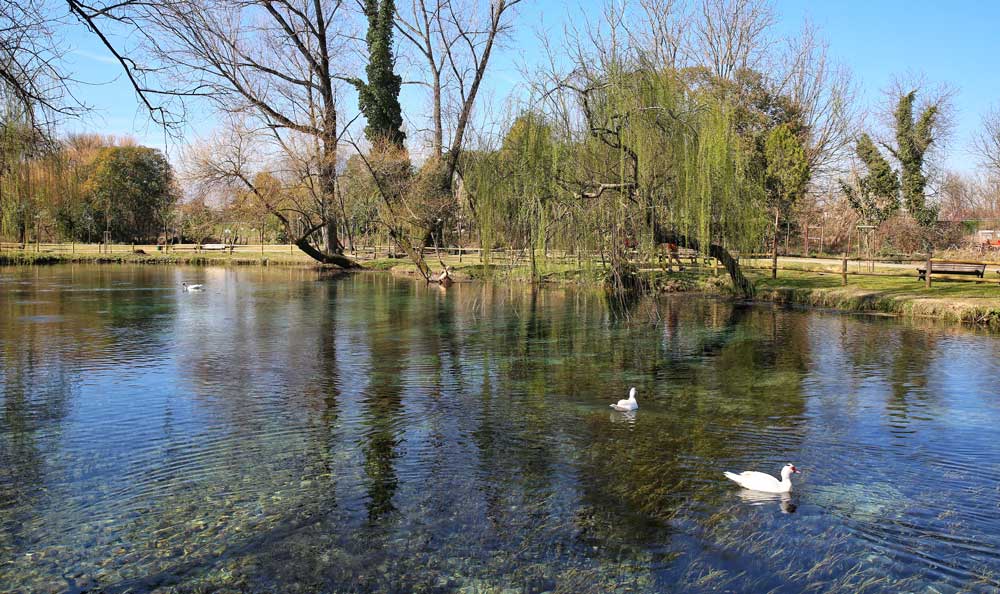
San Giorgio a Liri
We will start from the beautiful Small Lake Parco dei Mulini, in Ciociaria. Its clear, blue waters, gushing from a spring, have been hiding in their depths, a statue of the Madonna since 1982. Right now, we are going to explore San Giorgio a Liri, the village surrounded by the polygonal walls of Santa Lucia and Maceralonga. We will visit the Castle of Prince Rogero Morra, a former abbey, and the Church of San Rocco, dedicated to San Giorgio, the Patron Saint. In this area, grows the fragrant pennyroyal, excellent for seasoning frittatas or preparing the typical local liqueur.
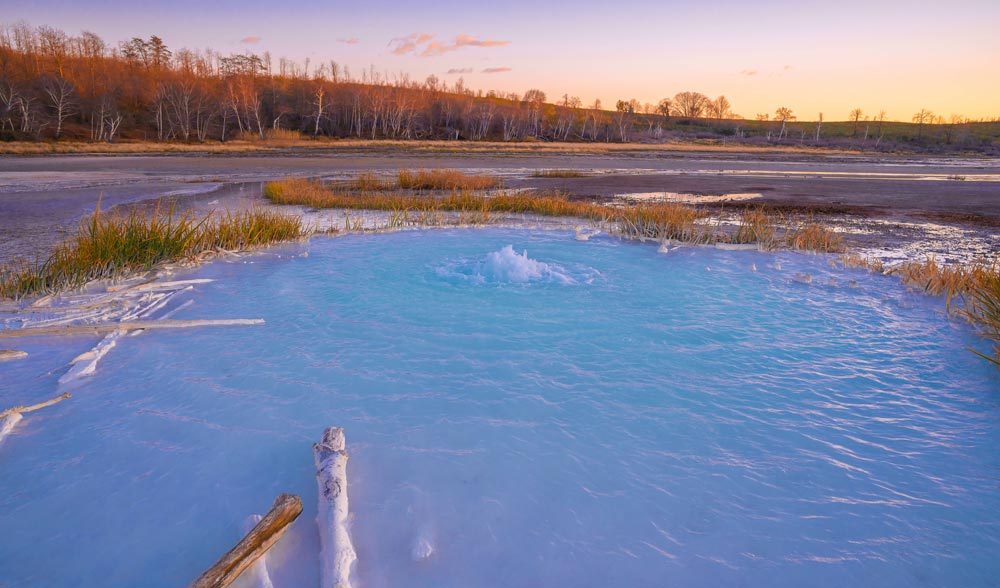
Caldara di Manziana
Among thickets of black alder, royal fern from Florida (Osmunda regalis) and white birch (Betula pendula), boiling sulphurous waters emerge from the Caldara di Manziana. This natural monument is part of the Parco Naturale Regionale di Bracciano e Martignano.
Its territory, the Silva Mantiana, was consecrated by the Etruscans to the God of the Underworld Mantus, hence the name of the area. Here, between the Tyrrhenian Sea and the Tiber Plain, at the end of the Sabatino volcanic complex, geysers are formed by rainwater penetrating the subsoil and reaching the magma.
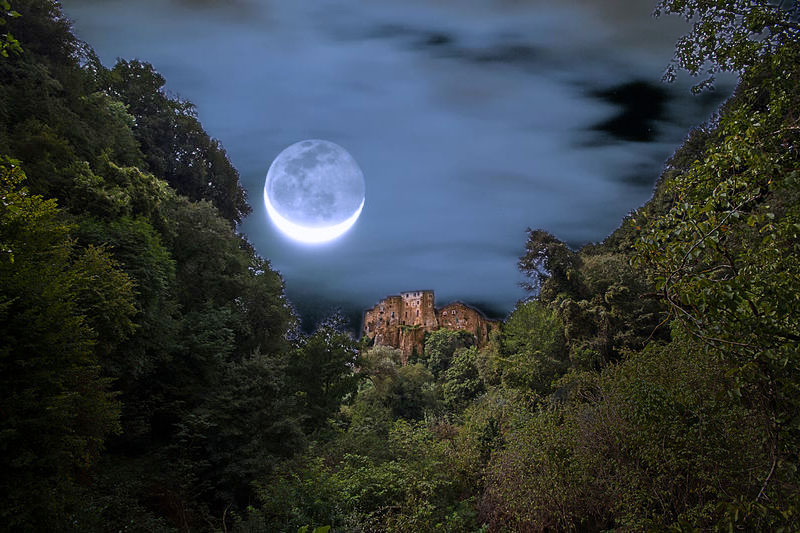
Corchiano e le Forre del Rio Fratta
Let us continue towards the Tuscia Viterbese, where, in Corchiano, we will discover a gorge of volcanic origin. The village is a maze of small alleys and squares overlooking the gorge Forra del Rio Fratta, a tributary of the Tiber River, which generated over the years a unique phenomenon in Europe. The Forre di Corchiano Natural Monument is a canyon originating from important volcanic events. The area is rich both in natural beauty and noteworthy evidence of the past: small prehistoric caves, tombs, Faliscan Vie Cave (sunken roads), Roman remains and a stretch of the Via Amerina.
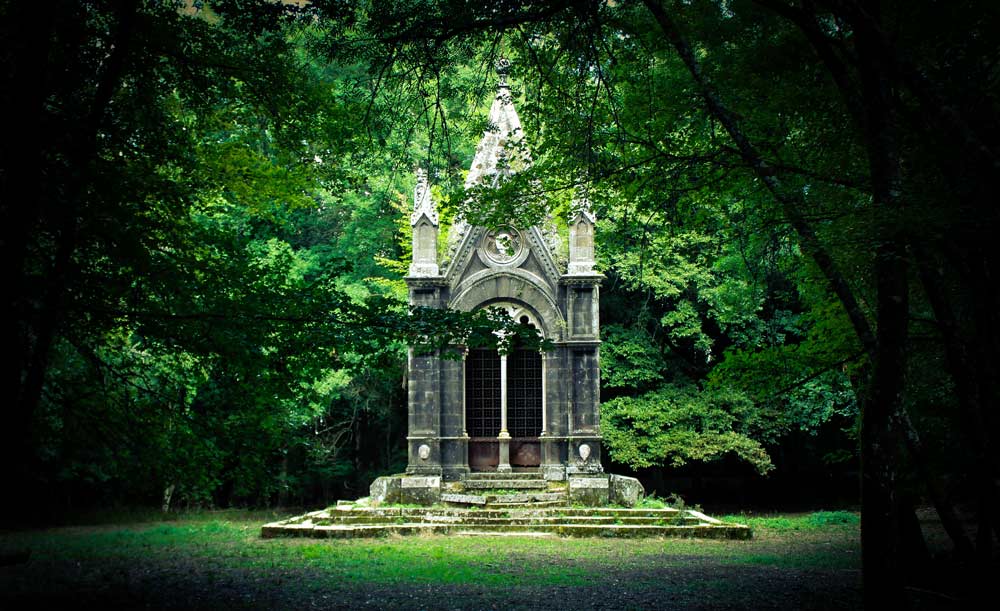
Sasseto Forest – Cahen Mausoleum
We reach Acquapendente and the Sasseto Monumental Forest in bloom. Durmasts, oaks, beaches, and hollies give way to velvety boulders covered with green moss and ruffled ferns at the edge the paths. Through twisted branches, we spot the battlements of the Castello Monaldeschi and, In the heart of the forest, an authentic jewel, the small neo-Gothic Mausoleum of Marquis Cahen who, at the end of the nineteenth century, made it accessible and chose it as his final home.
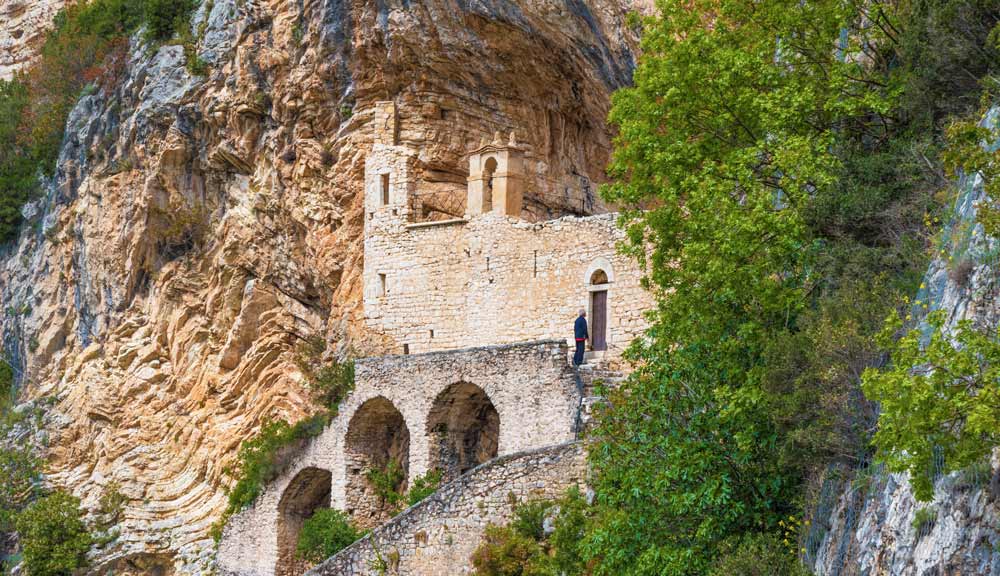
Hermitage of S.Cataldo – Cottanello
The Hermitage of San Cataldo in Cottanello in Sabina is also worth a visit. Nestled among the mountain granite rocks, it preserves three arches and two small bell towers, camouflaged in the landscape. According to the legend, the holes, small basins, and cracks in the rocks, along the way from the hermitage to the stream underneath, are the traces left by San Cataldo’s elbows, knees, and feet. Whenever the Saint descended to the stream in the morning, the rock turned soft, relieving his fatigue.
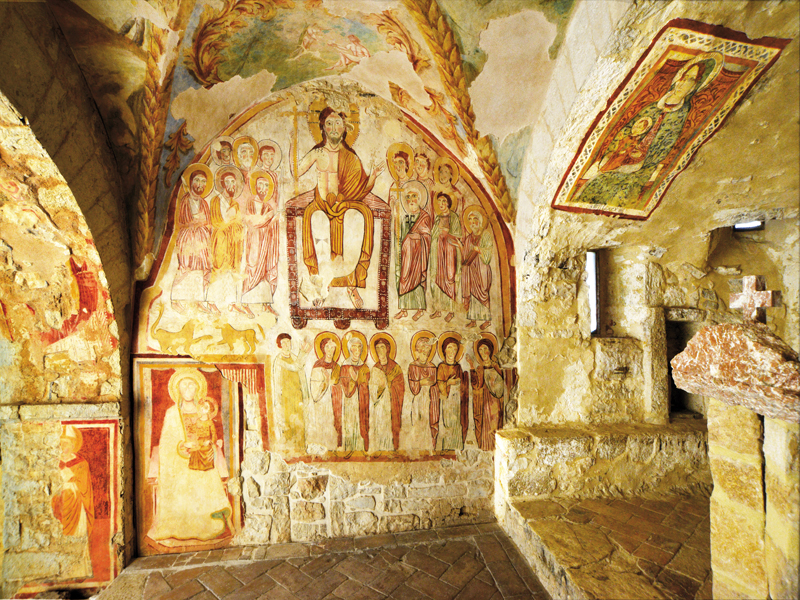
Hermitage of San Cataldo – www.comune.cottanello.ri.it
The Hermitage of San Cataldo hosts a masterpiece, considered the oldest fresco in the entire Sabina. Its Byzantine Christ, sitting on a jewelled throne among the twelve apostles, testify its origins from the eleventh or twelfth century. Christ has a Tau on his right leg, most likely painted by San Francesco between 1217 and 1223, in order to leave in the hermitage a trace of his passage.
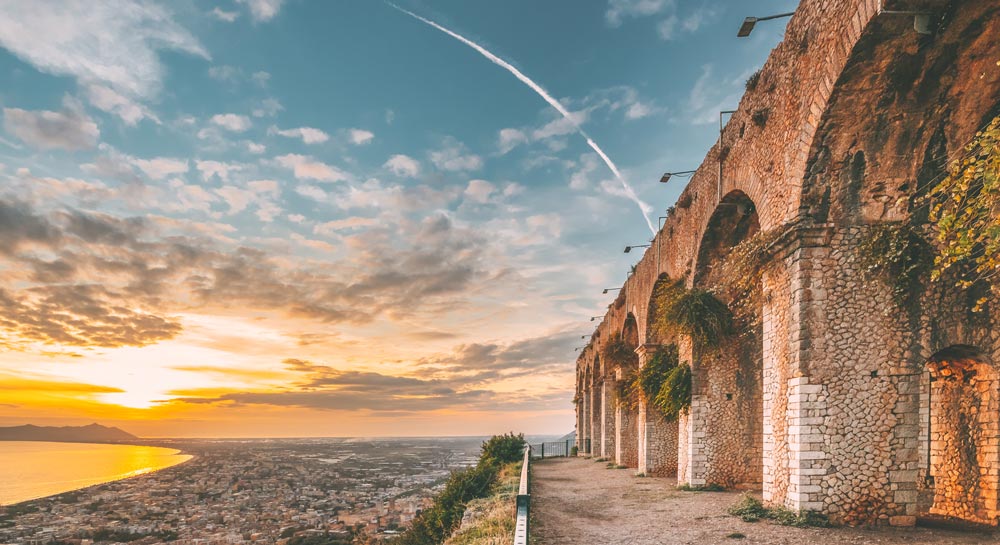
Temple of Jupiter Anxur in Terracina
The itinerary leads us to Terracina, where we can admire the Young Jupiter, or Jupiter Anxur, on Monte S. Angelo. This wonder was built in the Silla era, after the civil war won by Silla against Marius in 82 B.C.
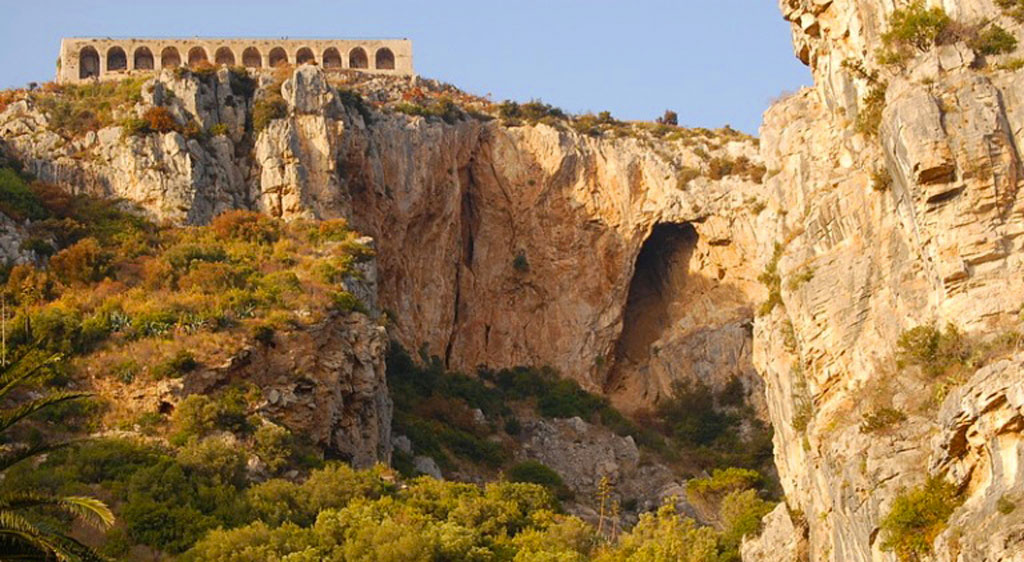
Monte S. Angelo with the Temple of Jupiter Anxur
The Temple of Jupiter Anxur is the most impressive building of this rich archaeological area. Here we can still marvel at the late-republican walls, interrupted by nine circular towers, the remains of a sanctuary and military settlements, a small temple dedicated to the Goddess Feronia, and the Monastery of S. Michele Arcangelo. On the lower mountain terrace, only the base of the temple, with its twelve arches leading to barrel vaulted rooms, is left.
The area also includes the 23 hectares of Monte S. Angelo, most of which have been recognized as Sito d’Interesse Comunitario. Here, among the typical Mediterranean flowers, various species of spontaneous orchids and cornflowers of the cliffs stand out, beneath the wings of migratory birds, such as the peregrine falcon and the common raven.